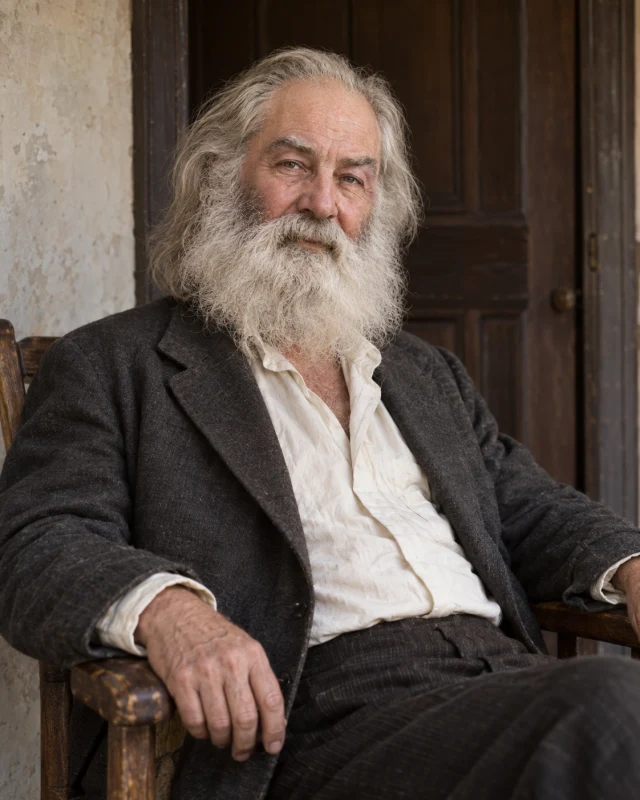
Leaves of Grass — Studio AI narration
“I celebrate myself, and sing myself, / And what I assume you shall assume.”
About this work
Leaves of Grass, first published in 1855 and rewritten and enlarged until Whitman's death, is the founding masterpiece of American poetry — home to "Song of Myself," "I Sing the Body Electric," "Crossing Brooklyn Ferry" and the great elegies of the Civil War. Sprawling, sensual, spiritual and defiantly democratic, it remade what a poem could sound like and who it could be for.
Whitman's lines were built for breath and voice, which makes hearing them transformative. This edition carries an extra charge of mystery: it takes its inspiration from the famously disputed recording said to be Whitman reading his poem "America" — though the voice you hear is our studio AI interpretation, not that cylinder, and not the bard himself.
Who was Walt Whitman?
Walt Whitman (1819–1892) was the great democratic poet of America — printer, journalist, Civil War nurse and visionary who broke the corset of English verse to write in long, surging, free-form lines that sounded like the country itself talking. He spent his whole life revising and expanding a single book, treating it less as a finished work than as a living organism that grew with him.
Whitman wanted, above all, to be heard. He wrote for the ear and the open road, for ferry crowds and battlefield wards, and he believed poetry belonged in the mouth and the body, not just on the page. Few writers' work begs more urgently to be read aloud.
About the voice
This edition uses a studio AI voice, not a restoration of Walt Whitman's recording. It is a new AI performance, not a recording of the author reading this work.
Provenance: Studio AI voice. We label every voice by the source used for this edition — restored, studio AI, or disputed.
Questions
Is this Walt Whitman’s recorded voice?
This edition uses a studio AI voice, not a restoration of Walt Whitman's recording. It is a new AI performance, not a recording of the author reading this work.
Is this Walt Whitman’s recorded voice?
This edition uses a studio AI voice, not a restoration of Walt Whitman's recording. It is a new AI performance, not a recording of the author reading this work.
Is Leaves of Grass in the public domain?
Yes. Leaves of Grass, in its editions published during Whitman's lifetime through 1892, is in the public domain in the United States and Canada, so it can be freely produced as an audiobook.
More iconic voices
Discover more voices
Get free sample recommendations and news about new releases. Unsubscribe at any time.